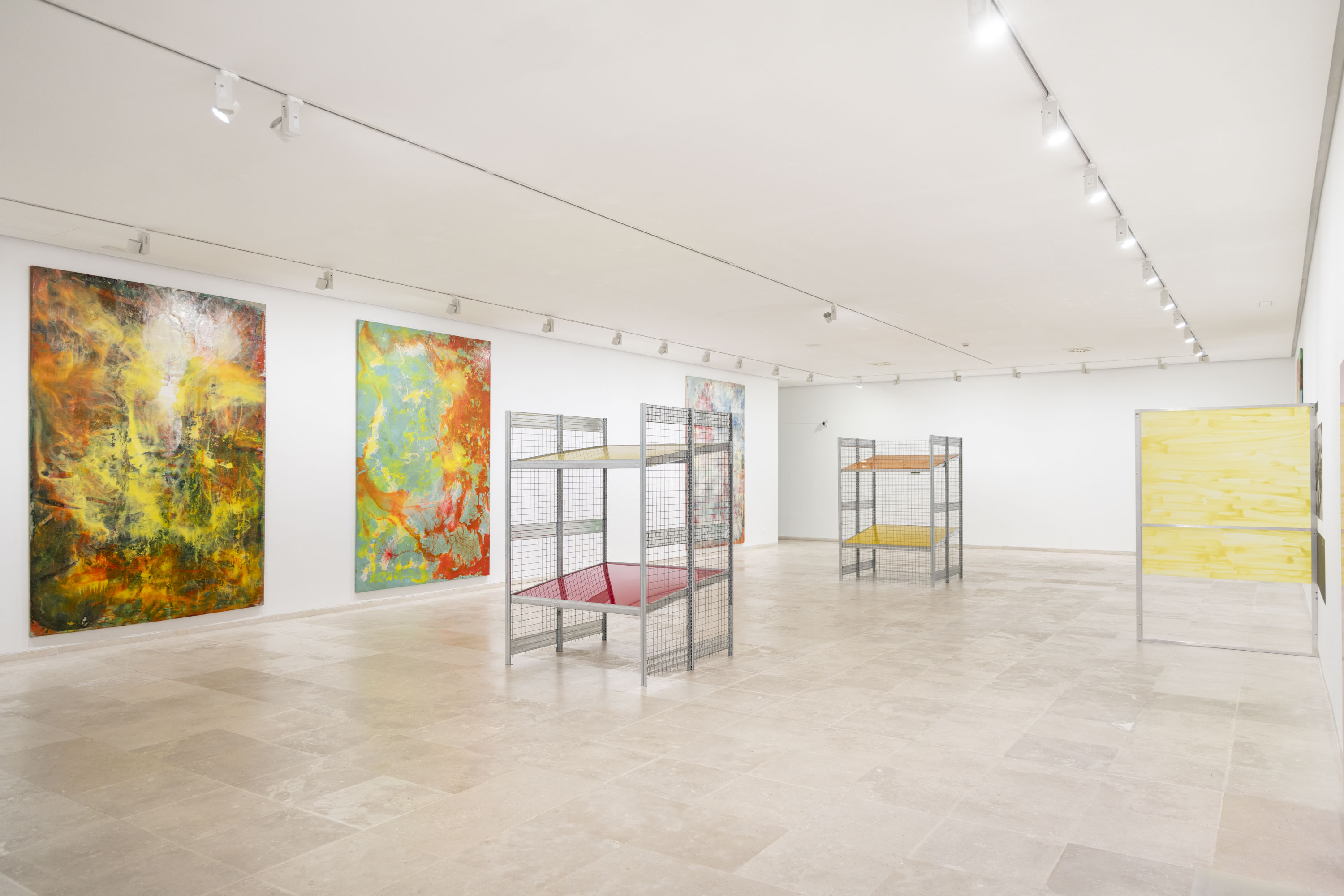
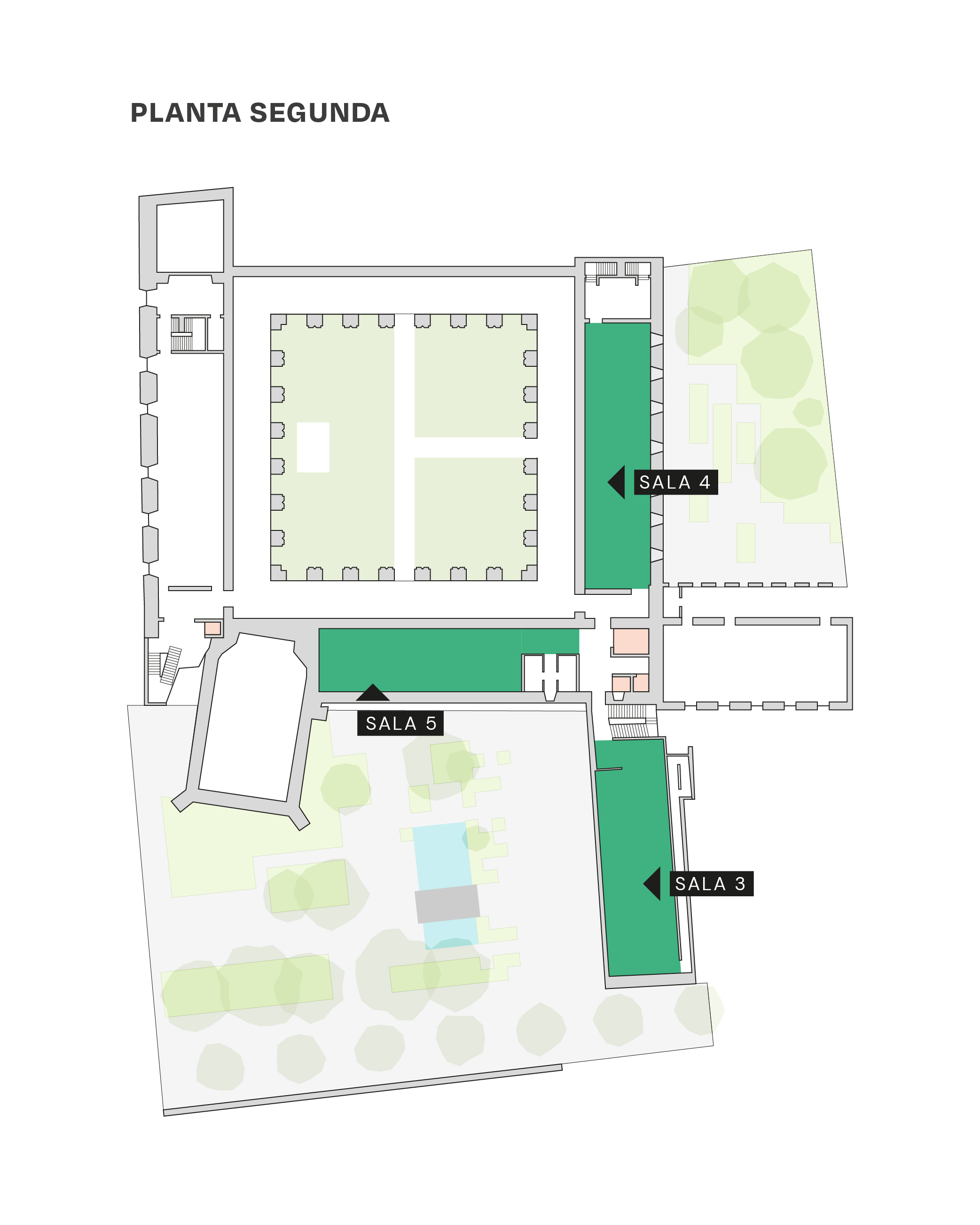
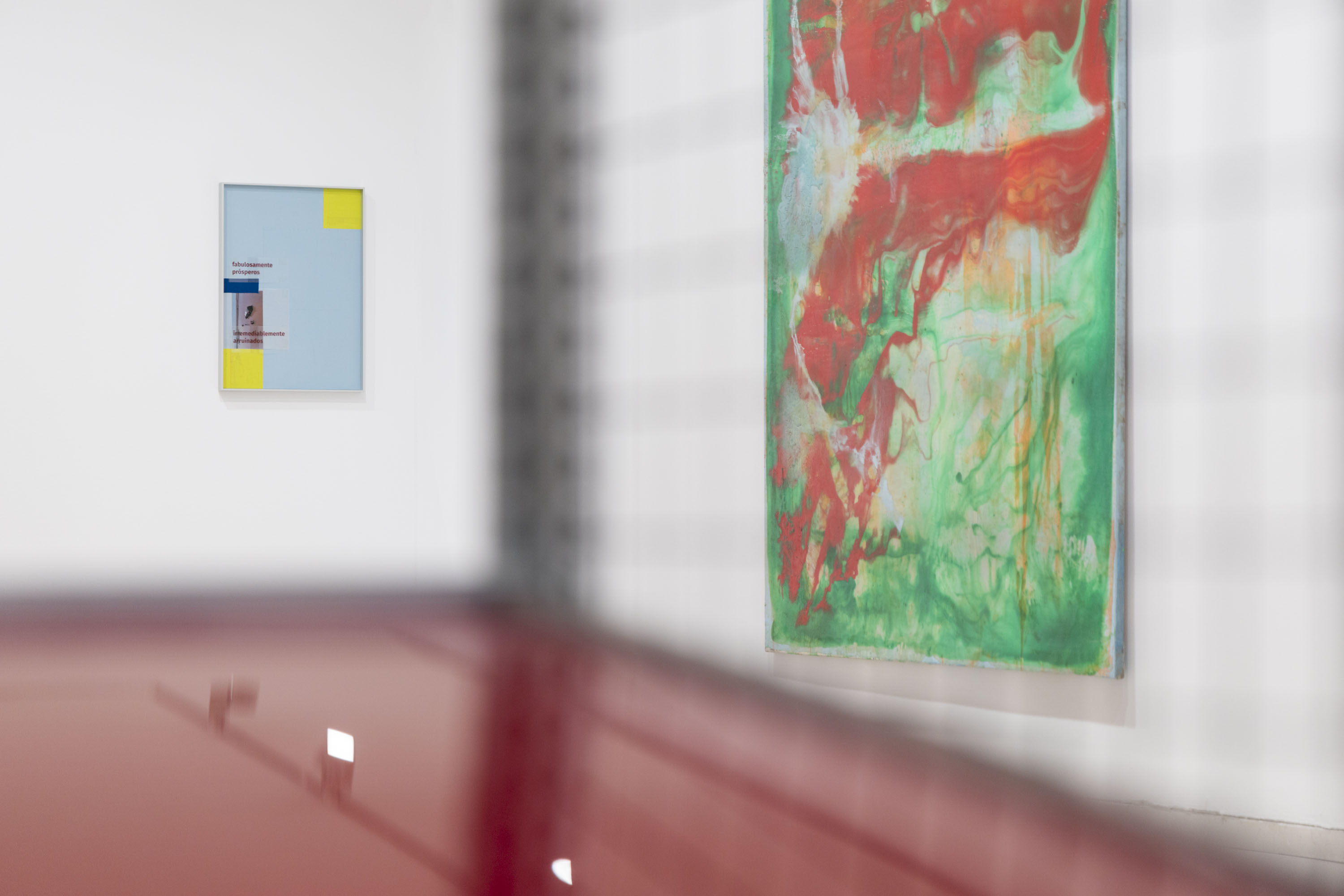
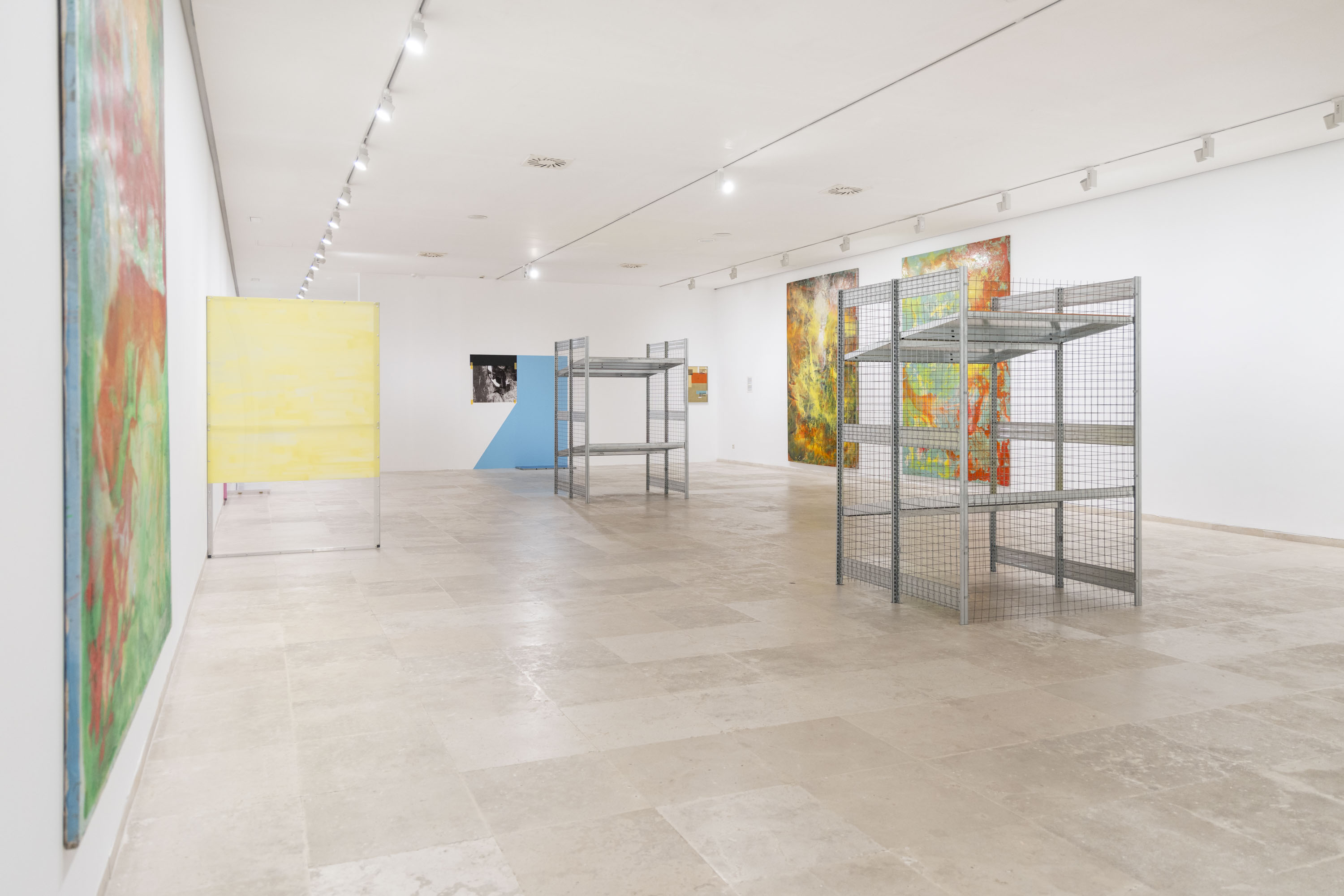
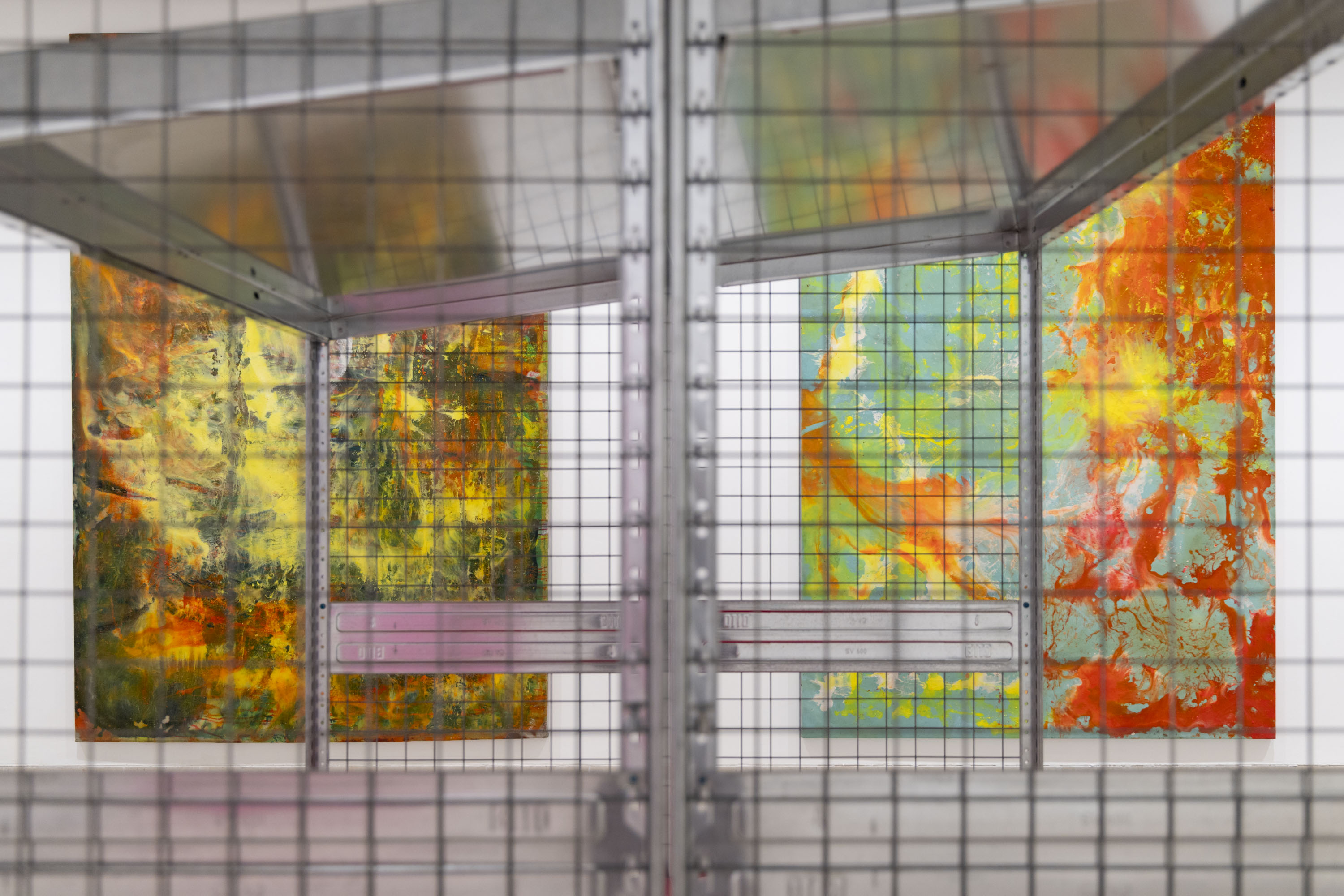
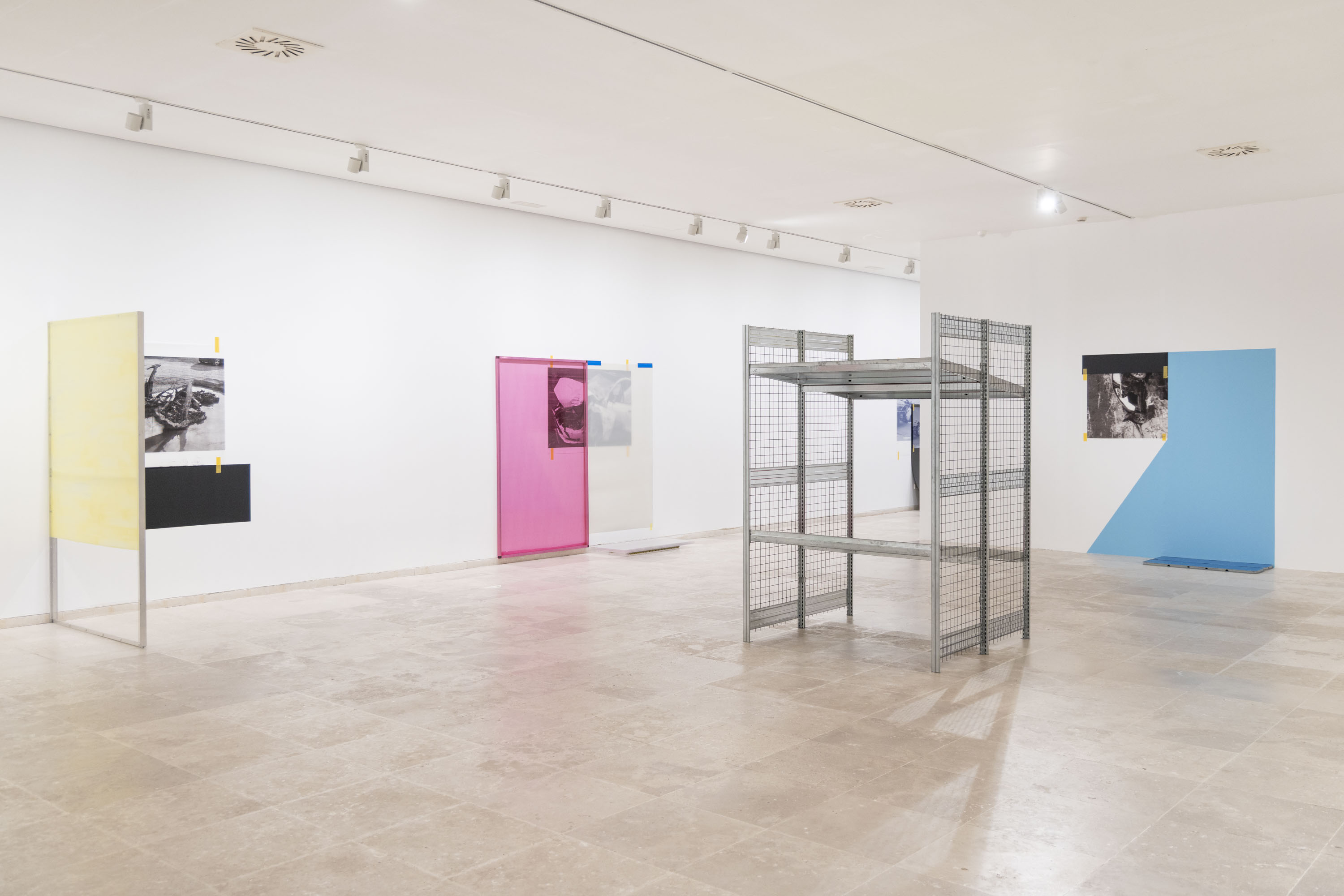
Las salas 3, 4 y 5 de la segunda planta, en la que recientemente ha podido verse obra de pintores también abstractos como Hernández Pijuan o Carlos León, acogen ahora obras de las principales series de Mont, quien, en una primera etapa, en los primeros años noventa y con un pie ya en París tras sus estudios en su Barcelona natal, practicaba una pintura de carácter gestual, si bien su soporte, el contrachapado, ya delataba un interés por la materia industrial que tanto se repetiría en adelante. Hablamos de la serie Dispersiones, que pueden verse en la sala 3, cuadros que rara vez se han visto juntos en tan generoso número y que son paradigmáticos de una etapa inicial en la que el artista desbroza la tradición de la pintura. Son especulaciones de juventud de quien va buscando un lugar pero con objetivos claros, pues en en esa profunda fase de indagación aborda un análisis de la gran pintura americana, explora la tradición española y también la historia de la pintura reciente de su país de adopción, Francia, donde reside desde entonces. Estas Dispersiones de tan enorme formato son resultado de toda esa investigación primera. No es baladí, sin embargo, que estas piezas se sitúen junto a la serie Realismo de mercado, estructuras tridimensionales modulares, a medio camino entre lo funcional y lo estético. El fragor del gesto en las Dispersiones se abraza al frío metal de las esculturas y a la plana e impersonal disposición de la pintura que en ellas se inscribe. Estas ya son obras de mediados de los dos mil, años especialmente fecundos que ven germinar un buen número de grupos de trabajo. Tampoco es casual que en torno a ellas se puedan ver trabajos de la serie Tesla, que alude a los coches de la firma estadounidense, símbolo de perfección y trofeo de la técnica, el epígono de un progreso que no se consigue a cualquier precio, pues todo triunfo tardocapitalista solo trae consigo desajustes, desequilibrios y desigualdades en las sociedades de nuestro tiempo. Mont presenta aquí, además de un perfil claramente crítico, una reflexión en torno al dispositivo, un término muy común en el argot del arte contemporáneo que alude a los medios de los que nos servimos para poner el discurso sobre la mesa, nuestra forma de contar, en una palabra. Tiene generalmente un perfil escenográfico, pues las situaciones bajo las que se dan tienden a estar nítidamente organizadas bajo un criterio concreto. No descubrimos nada diciendo que la forma de contar es tan importante como lo que se cuenta, así, el dispositivo es ya casi una suerte de subgénero artístico, del que Mont participa o, al menos, observa con interés. En sus Tesla, acude a internet para incorporar imágenes de accidentes a un elenco de materiales que se nos revelan en variadas disposiciones, atravesadas por formas diferentes de aplicar y hacer visible la pintura. El accidente aparece velado, y la imagen pasa a reconfigurarse, a tornarse en otro código visual.
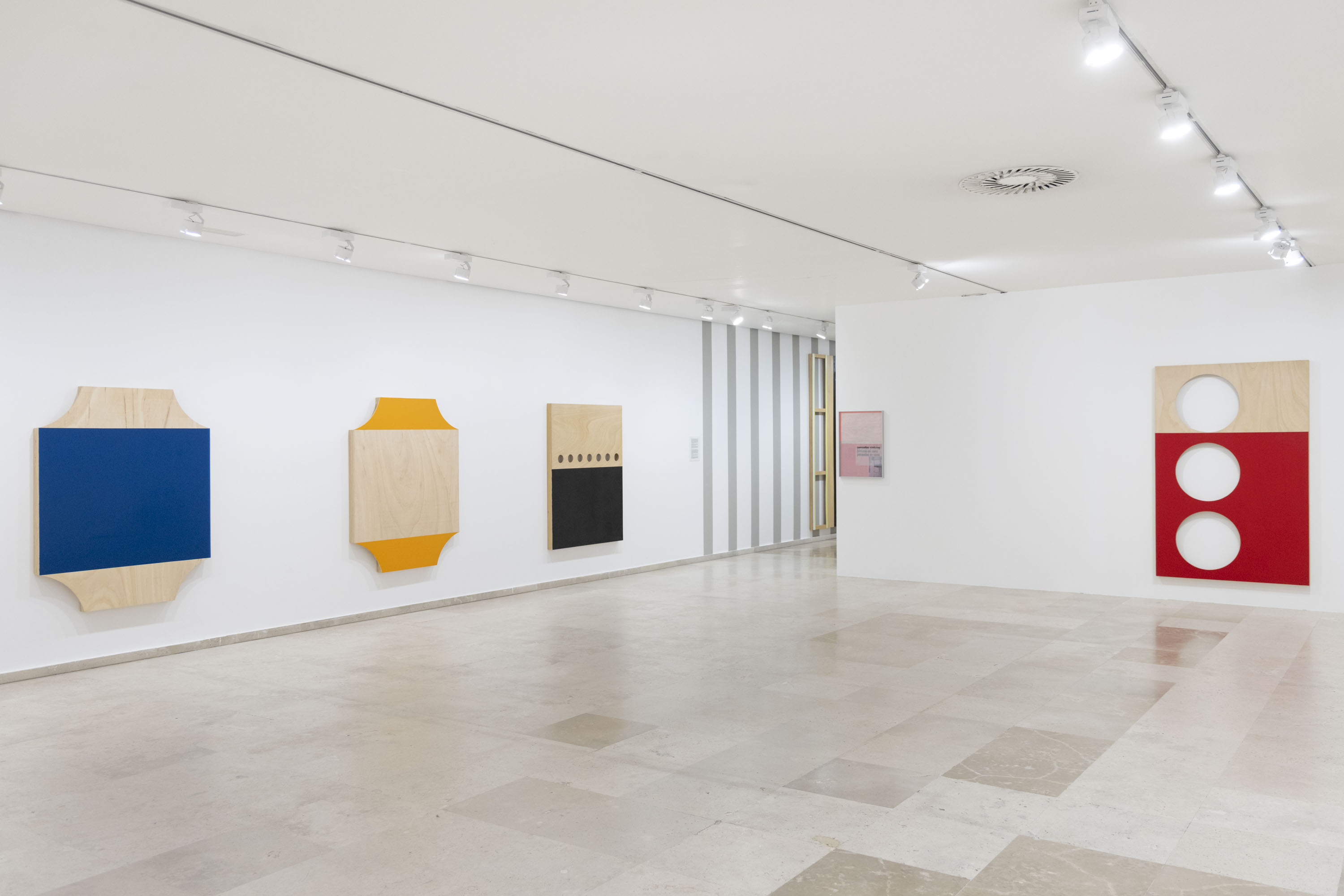
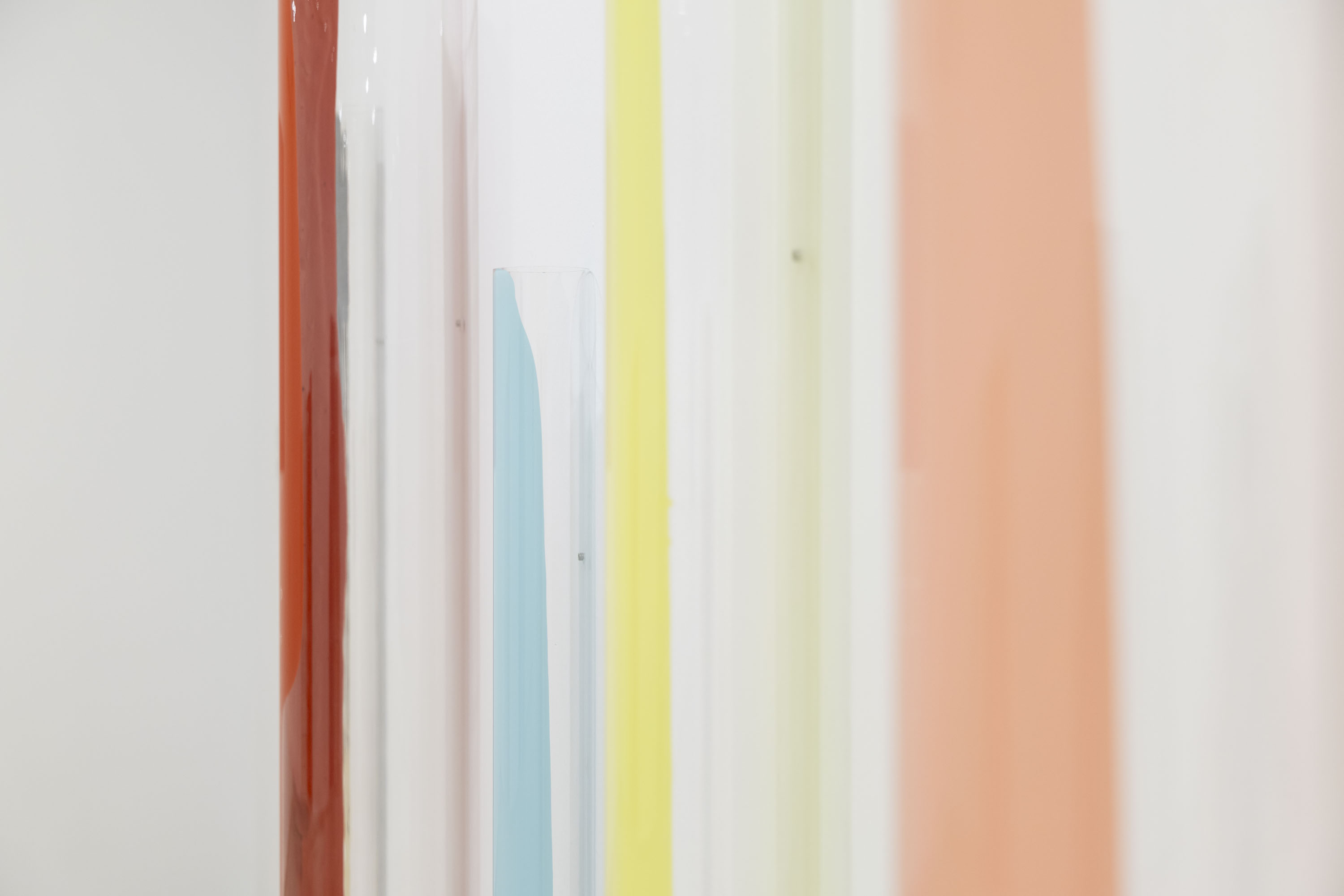
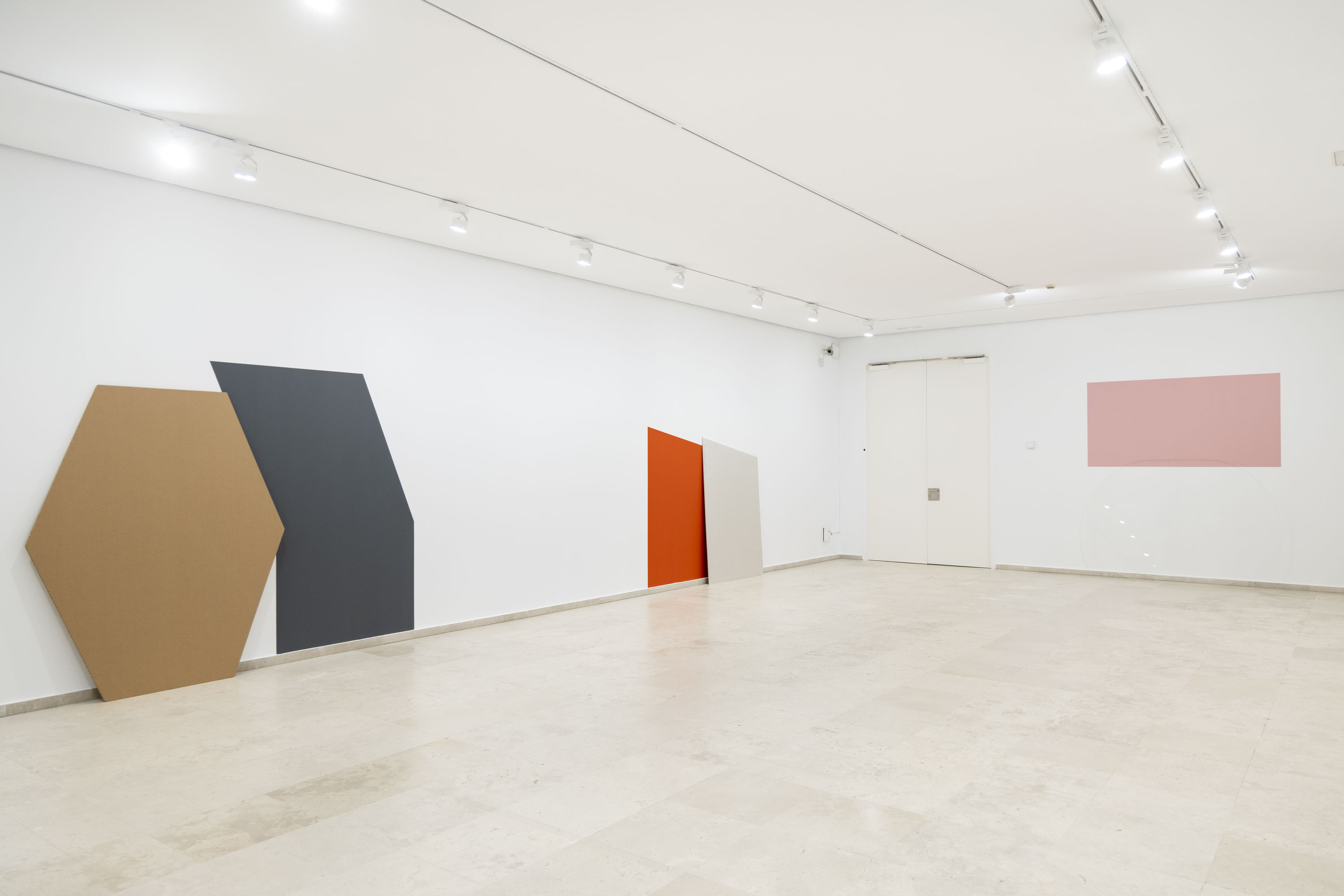
La sala 4 arranca con una de las pinturas murales de las que Mont ha hecho seña de identidad, interesado siempre en la textualidad, la dimensión escenográfica de la escritura, la tipografía y la voz de las subjetividades. Lo que leemos tiene interés desde la forma del propio texto -a medio camino entre lo caligráfico y lo tipográfico, esto es, entre una voz que se labra y otra que se produce en cadena- y desde lo que el texto cuenta: un trasunto que tiene tanta potencia política como calado poético. La pieza tiene una relación clara con los “collages ideológicos” que encontramos en todas las salas. El texto se filtra en la imagen, dotándola de un sentido que articula toda la exposición. Nos desliza el mural hacia un espacio en el que vemos dos series de trabajo gran relevancia, las Cooperaciones y los Lapsus, y, en última instancia, ya a la fondo de la sala, sus célebres Autorretratos. Las Cooperaciones expresan también con precisión que la soledad individual del artista, y su arraigo histórico, es mediatizada ineludiblemente por las circunstancias sociales que determinan su quehacer. La condiciones bajo las que son producidas las piezas, nos acercan más a un deslizante barroquismo que a una certeza clásica, pues, en cada una de las obras, Mont parece disolverse en una autoría múltiple, como si todo un acervo social pudiera intervenir en su realización, de ahí el título de la serie. Él mismo traslada aspectos relacionados con la pintura, como la transparencia y la opacidad, al espacio político, trenzando un paralelismo entre la pintura y el lenguaje financiero. Bien podrían asimismo adscribirse estos términos a la pesarosa actualidad política. Los Lapsus que jalonan el lugar son, en esencia, eso: una interrupción, una fractura, un dislocación, leve en la forma y en el espacio, fulminante en el tiempo, propia del lenguaje. De la pintura, una mancha etérea, dispuesta directamente sobre muro, se desprende una forma análoga de materia industrial, cartón, metacrilato o pladur, y el resultado es como una frase que perdió una sílaba por el camino. Al final de la sala, los Autorretratos se disponen en una secuencia de tubos de metacrilato. Mont ha pintado una mancha en su interior. El tamaño de cada tubo está íntimamente ligado a su cuerpo, a todo su cuerpo o a partes de él, sean torsos, tibias, radios, palmos, dispuestos en rítmica coreografía. Todo lo que verán en la exposición, y la forma en la que todo está instalado, tiene relación, decíamos, con su cuerpo.
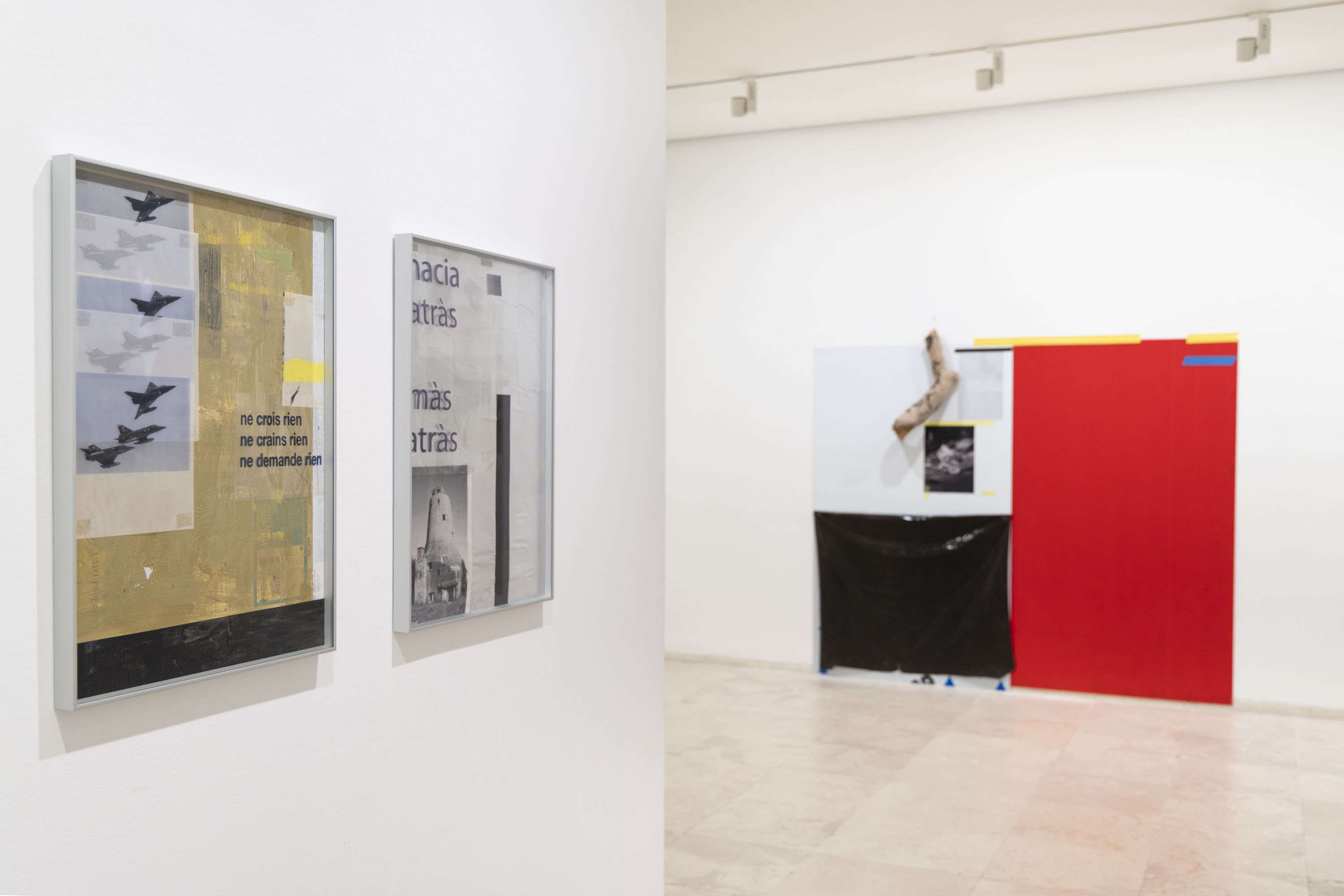
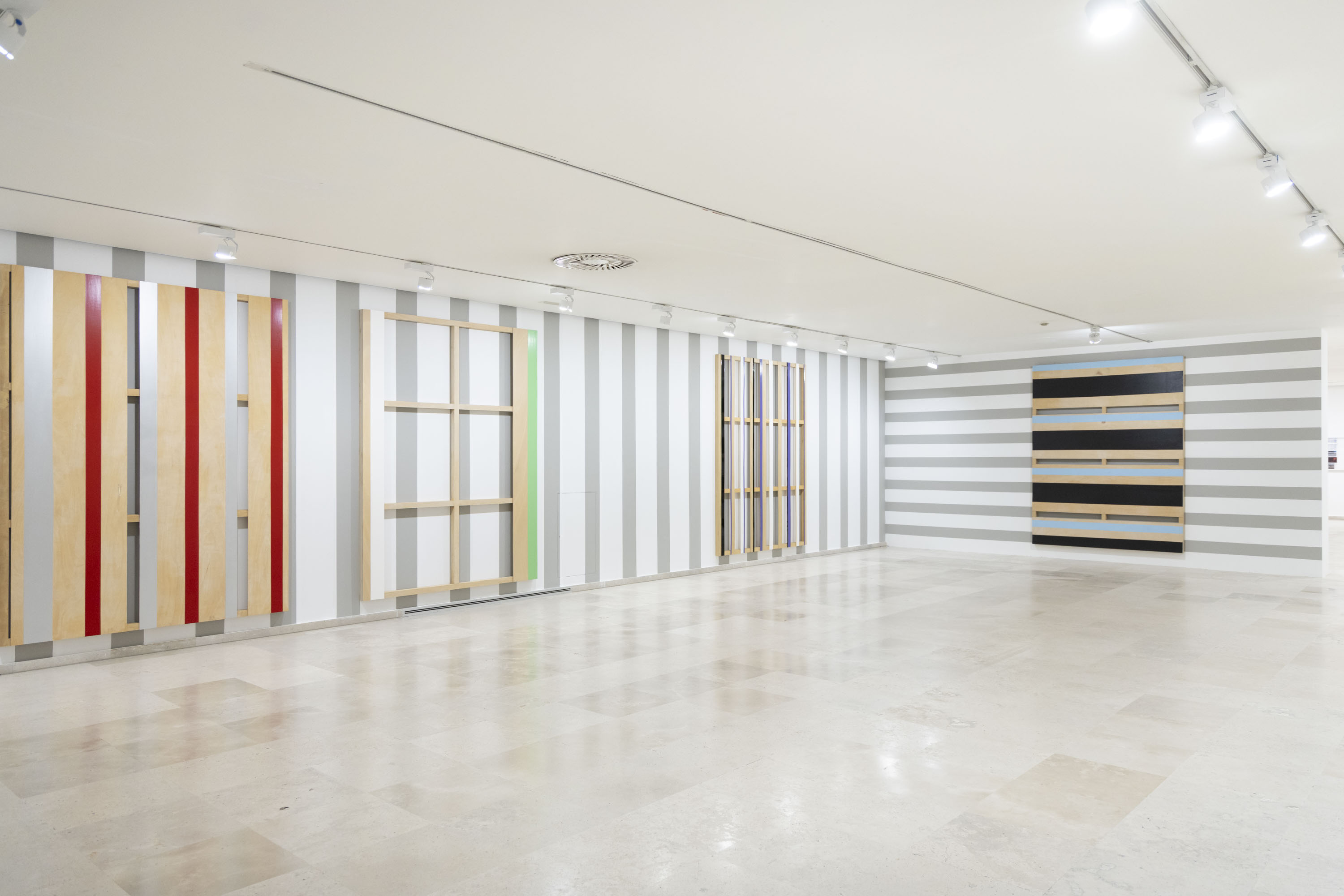
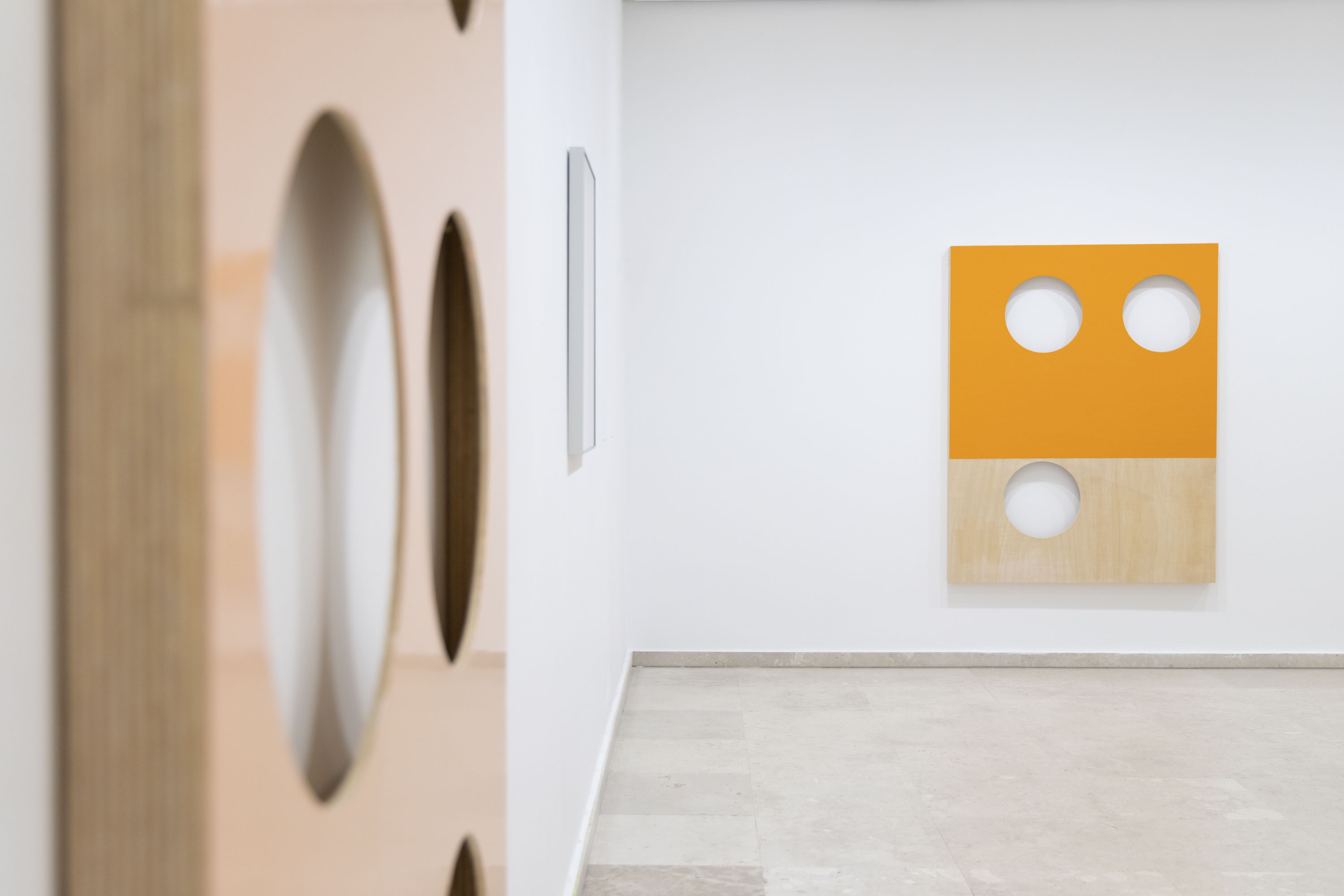
En la Sala 5 observamos un número importante de obras de la serie Flicker, que están dispuestos sobre una intervención pictórica en el muro. La voz inglesa “flicker”, quiere decir “parpadeante”, y se utiliza mucho en relación a la luz. Así, “a flickering light” es una luz parpadeante, expresión que bien podría adscribirse al trabajo de Miquel Mont en este espacio, un continente tornado en contenido donde los elementos constitutivos de la pintura se dan cita en un espacio dinámico, casi trepidante, con tensión rítmica entre llenos y vacíos, entre lo industrial y lo orgánico, entre imagen y forma. Mont sitúa en su origen el interés que en él siempre despertaron los “Flicker films”, las películas experimentales con sus incursiones en la abstracción y el frenético encadenamiento de las imágenes. En la siguiente sala, ocupada por la serie Poros se habla explícitamente de esa condición epidérmica de la pintura, la relación entre el tiempo y la acción de pintar, el ejercicio reflexivo de la producción de una superficie impecable, como si estuviera desligada del quehacer humano pero que resulta de un ejercicio perseverante y atento por parte del artista.
Forget delete, delete slowly is the title of this large-scale exhibition that the Patio Herreriano Museum has devoted to Miquel Mont, a leading figure in the Spanish painting scene in recent decades; an artist rooted in abstraction, yet whose work reveals clear notions of the realism of our times, or rather, an inquisitive exploration of our social space. His work, therefore, is abstract in form, and yet realistic and deeply sceptical in substance. Formally, it delves into a reflection on actual painting, its elements and the very act of painting itself. Concepts such as scale, density, matter, colour, surface, stains, accumulation, rhythm, transparency and opacity are all woven into a body of work that also maintains a close relationship with the body – both his own and that of the people who move around each piece.
Rooms 3, 4 and 5 on the second floor, which have recently featured pictures by other abstract painters such as Hernández Pijuan and Carlos León, are now hosting pieces from Mont’s major series. Early on in his career, in the early 1990s – with one foot already in Paris after his studies in his native Barcelona – he practised a gestural style of painting, although his choice of medium – plywood – already revealed an interest in industrial materials that recurred so frequently thereafter. We are referring to the Dispersions series, on display in Room 3: paintings that have rarely been seen together in such large numbers and which are emblematic of an early phase in which the artist broke free from the traditions of painting. These are the youthful explorations of someone seeking his place in the world, but with clear goals, for in that profound phase of inquiry he undertook an analysis of great American painting, explored the Spanish tradition and also the history of recent painting in his adopted country, France, where he has lived ever since. These large-format Dispersions are the result of all that early research. It is no coincidence, however, that these pieces are situated alongside the Market Realism series, modular three-dimensional structures, halfway between the functional and the aesthetic. The intensity of the gesture in the Dispersions embraces the cold metal of the sculptures and the flat, impersonal arrangement of the painting within them. These are now pieces from the mid-2000s, particularly fruitful years that saw the emergence of a number of working groups. Nor is it coincidental that pieces from the Tesla series can be seen alongside them; they allude to the cars of the American firm, a symbol of perfection and a trophy of technology, the epitome of progress that is not achieved free of cost, as every late-capitalist triumph only involves imbalance, disparity and inequality in the societies of our time. Here, Mont presents not only a clearly critical perspective but also a reflection on the device – a term common in contemporary art jargon that refers to the means we employ to put discourse on the table, our way of telling a story, in a word. It generally has a scenographic nature, as the situations in which it occurs tend to be clearly arranged according to a specific criterion. We are not revealing anything new by saying that the way we tell a story is just as important as what is actually told; thus, the device has now almost become a kind of artistic subgenre, in which Mont participates or, at the very least, observes with interest. In his Tesla series, he turns to internet to incorporate images of accidents into a range of materials that are revealed to us in varied arrangements, traversed by different ways of applying and making the paint visible. The accident is veiled, and the image is reconfigured, thereby becoming another visual code.
As you go into Room 4 you come across one of the mural paintings that have become Mont’s trademark, reflecting his enduring interest in textuality, the scenographic dimension of writing, typography and the voice of subjectivity. What we read is of interest both in terms of the form of the text itself – halfway between calligraphy and typography, that is, between a hand-crafted voice and one produced in a chain – and in terms of what the text conveys: a reflection that possesses as much political power as poetic depth. The piece has a clear connection with the “ideological collages” found in every room. The text filters into the image, endowing it with a meaning that binds the entire exhibition together. It guides us from the mural towards a space where we can see two highly significant series, the Cooperations and the Lapsus, and finally, at the far end of the room, his well-known Self-Portraits. The Cooperations also show with great precision that the artist’s individual solitude, and his historical roots, are inevitably shaped by the social circumstances that determine his work. The conditions under which the pieces are produced bring us closer to a shifting Baroque style than to classical certainty, for in each of the pieces, Mont seems to dissolve into multiple authorship, as if an entire social heritage could intervene in his creation – hence the title of the series. He himself transfers aspects related to painting, such as transparency and opacity, to the political sphere, weaving a parallel between painting and financial language. These terms could equally well be applied to the current gloomy political climate. The Lapsus that are dotted around the space are, in essence, just that: an interruption, a fracture, a dislocation, slight in form and space, devastating in time, characteristic of language. From the painting, an ethereal stain, applied directly to the wall, emerges a similar form of industrial material – cardboard, methacrylate or plasterboard – and the result is like a phrase that has somehow lost a syllable along the way. At the end of the room, the Self-Portraits are arranged in a sequence of methacrylate tubes. Mont has painted a stain inside them. The size of each tube is intimately related to his body, to his whole body or parts of it – be they torsos, shins, forearms, or palms – arranged in a rhythmic choreography. Everything you will see in the exhibition, and the way in which everything is installed, relates, as we said, to the artist’s body.
What we see in Room 5 is a significant number of pieces from the Flicker series, arranged over a pictorial intervention on the wall. The word ‘flicker’ means the same as ‘to twinkle’ and is frequently used in relation to light. Thus, a ‘flickering light’ is a blinking light, an expression that could well be applied to Miquel Mont’s work in this space, a container transformed into content where the constituent elements of painting come together in a dynamic, almost frenetic space, with rhythmic tension between solids and voids, between the industrial and the organic, between image and form. Mont traces the origin of his work to the interest he has always had in “Flicker films” – experimental films with their forays into abstraction and the frenetic succession of images. In the next room, taken up by the Pores series, there is an explicit exploration of painting’s skin-deep nature, the relationship between time and the act of painting, and the reflective process of creating a flawless surface – as if detached from human endeavour, yet resulting from the artist’s persistent and attentive labour.